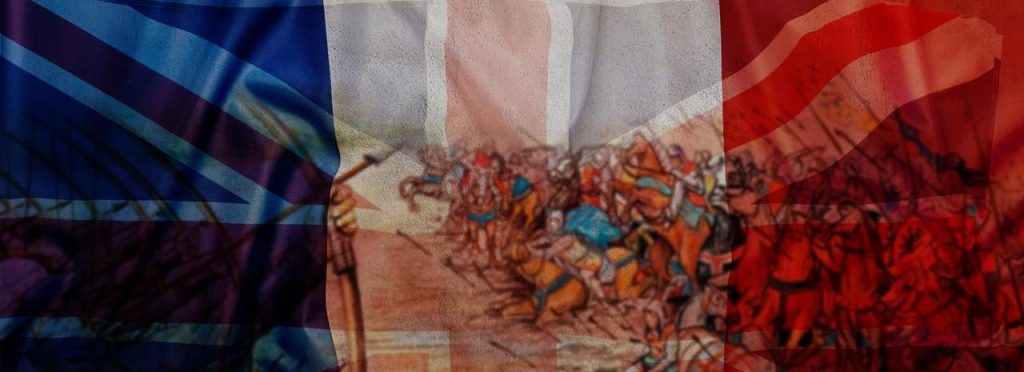
The Hundred Years’ War was not a single, continuous war, but rather a series of conflicts fought between England and France from 1337 to 1453. Spanning 116 years, this protracted struggle reshaped medieval Europe, led to dramatic military and political developments, and gave rise to some of history’s most legendary figures, including Joan of Arc and Edward the Black Prince.
At its heart, the war was a dynastic dispute over the French crown, but it also involved deep economic, feudal, and nationalistic motivations that would ultimately redefine both nations.
Background: The Seeds of Conflict
The origins of the war trace back to a complex web of feudal ties between English and French royalty. Following the death of Charles IV of France in 1328, who left no male heir, a succession crisis erupted. Edward III of England, grandson of the former French king Philip IV, claimed the French crown through his mother Isabella.
However, the French nobility rejected Edward’s claim, invoking Salic Law, which prohibited inheritance through the female line. Instead, they crowned Philip VI of Valois, sparking resentment in England and sowing the seeds of war.
But the struggle was not solely dynastic. Control over rich French territories, especially Aquitaine, and the lucrative wool and wine trades, also fueled the tension between the two kingdoms.
Phase 1: The Edwardian War (1337–1360)
Edward III officially declared himself King of France in 1340, escalating the dispute into open warfare.
Key Events:
Battle of Crécy (1346): A decisive English victory showcasing the effectiveness of the longbow against French knights. Siege of Calais (1347): Edward captured the strategic port, which remained under English control for over two centuries. Black Death (1347–1351): This pandemic ravaged both countries, killing millions and disrupting military operations.
The war during this phase concluded with the Treaty of Brétigny (1360), which temporarily favored the English, granting them vast lands in southwestern France and a hefty ransom for the captured King John II of France.
Phase 2: The Caroline War (1369–1389)
Named after Charles V of France, the Caroline phase began when the French sought to reclaim lost territory.
Key Developments:
French forces, under commanders like Bertrand du Guesclin, used guerrilla tactics and avoided large battles, gradually regaining control of territories. England, under Richard II, suffered from internal strife and weak leadership, diminishing their position in France.
This phase ended in 1389 with the Truce of Leulinghem, offering a brief period of peace.
Phase 3: The Lancastrian War (1415–1453)
The most famous and final phase began when Henry V of England revived the English claim to the French throne.
Key Events:
Battle of Agincourt (1415): Perhaps the most iconic battle of the war; English forces, outnumbered and weary, achieved a miraculous victory thanks to the longbow and muddy terrain. Treaty of Troyes (1420): Recognized Henry V as heir to the French throne, disinheriting the Dauphin (Charles VII). Death of Henry V and Charles VI (1422): Their deaths left an infant Henry VI as king of both England and France—an unstable and contested claim.
The Rise of Joan of Arc and the Turning Tide
The course of the war dramatically shifted with the emergence of Joan of Arc, a peasant girl who claimed divine guidance. In 1429, she inspired the French to:
Lift the Siege of Orléans Crown Charles VII at Reims Cathedral
Although Joan was captured by the Burgundians, sold to the English, and executed for heresy in 1431, her martyrdom sparked a wave of French nationalism and unified resistance.
The End of the War (1453)
By the 1440s, the French military, restructured under Charles VII, became more professional and effective. England, on the other hand, was weakened by political infighting and the beginning of the Wars of the Roses.
Battle of Castillon (1453) marked the final blow: the French decisively defeated the English and reconquered Bordeaux, ending English rule in France (except for Calais).
Consequences of the Hundred Years’ War
Military Innovations:
Decline of chivalric warfare; rise of infantry and artillery Use of the longbow, gunpowder, and cannons
Political and Social Impact:
England: Financial exhaustion, decline of feudalism, and internal conflict (Wars of the Roses) France: Emergence of a strong central monarchy and growing national identity
Rise of Nationalism:
A new sense of French identity emerged, influenced by the heroism of Joan of Arc and the struggle against a foreign power. English identity began to detach from continental Europe, laying early groundwork for a more insular policy.
Conclusion
The Hundred Years’ War was a transformative period in European history. It began as a dynastic quarrel over a crown, but it ended as a redefinition of nations, warfare, and political structures. The conflict gave birth to new heroes, new weapons, and new ways of thinking about power and identity.
Far from being just a medieval feud, the Hundred Years’ War was a turning point that marked the end of the Middle Ages and the dawn of the modern European state.



 Fikir Yolu
Yorum bırakın